
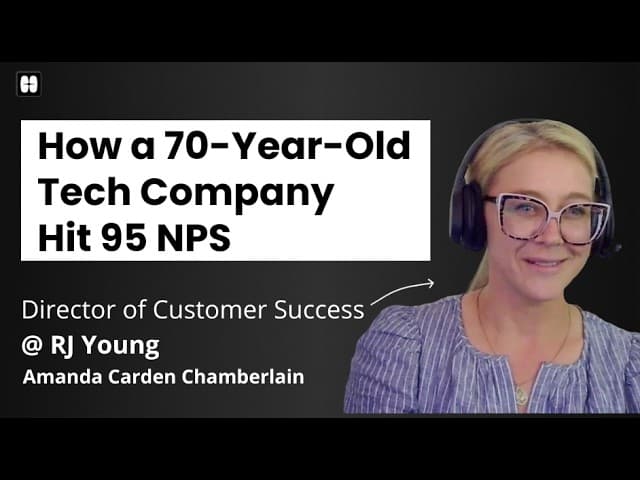
CX Heroes Podcast #48: The Support Agent Role Is Being Rewritten. Most Teams Aren't Building For It Yet.
The support agent job description is being rewritten right now, and most support leaders have not noticed yet.
Amanda Carden-Chamberlain has been in customer experience for 17 years, across food service, e-commerce, wine distribution, and enterprise technology. She is the Director of Customer Success at RJ Young, a 70-year-old Southeast US business technology company that grew from printers and copiers into full managed IT infrastructure during COVID. She manages 30 products and hit 95 NPS last month.
When she describes what the role looks like in 2028, it is not a support agent anymore.
What is left when AI takes the routine work
Amanda's logic is simple. When AI absorbs the password resets, the order lookups, and the ticket entry, what remains for the human on the team is the work that actually requires a person. The emotionally charged interaction. The problem with no obvious solution. The customer who needs to feel genuinely heard by someone who understands the situation.
She has a name for the person who does that work. A CX champion. Someone whose entire job is the high-stakes conversation.
The implication is significant, and it is where most teams fall behind. If the repetitive work disappears into automation, the people who remain have to be equipped for a completely different kind of interaction. Hiring criteria change. Training changes. What success looks like changes. Most support teams are not building toward that yet. They are automating the easy half of the job and assuming the people will sort themselves out around it.
The structure is the strategy
Ask Amanda what makes 95 NPS possible and she points at the org chart, not a tool. RJ Young runs three separate support teams, each built around a specific product set, each accountable for becoming genuinely expert in its area.
"A master of all is a master of none. We try to have it so that each team has their focus so that they can truly become experts in that area."
The structure is the strategy. The score is the evidence. That focus is also exactly what makes a CX champion role workable: you cannot ask someone to handle the hardest conversations in a category they only half understand.
What a credible AI pitch has to clear
Amanda deletes most AI vendor pitches before finishing the first message. She knows the landscape better than most of the people selling to her, and she has a fast filter.
"Any time somebody comes to me with a right off the bat first message pitch of 'This is going to solve all of your problems,' I am not going to believe that, and I will probably not even look into it."
Her evaluation starts with one question: tell me about a company in my space where this worked. Most vendors cannot answer it.
There is pressure from above, too. The same pitch landing in her inbox is also landing with her CEO and her C-suite. Because they do not always know the inner workings of what it takes to take care of a customer, the pressure comes back down as a question: why are we not already doing this? Amanda has had to build the case from the inside, and credibility is the currency. RJ Young already runs Agent Assist, surfacing resources for agents mid-conversation in real time, and she is actively evaluating the next layer.
The takeaway for CX leaders
If you are planning your support org for the next three years, Amanda's view is a useful gut check. Automation is not the finish line. It is the thing that changes what your remaining people need to be. The teams that win will redesign the human role on purpose, hire and train for the high-stakes conversation, and refuse to let the easy wins of automation define the whole strategy.
That is also how we think about Helpfeel. The point of taking routine questions off your team's plate is not a smaller team. It is a team pointed at the work that only people can do. The next hire you make should be a CX champion, not a ticket router.
The full episode covers how Amanda builds the internal case for AI, what 17 years across four industries taught her about reading a vendor, and the role she believes every support team will be hiring for by 2028.
Watch the full episode of CX Heroes with Amanda Carden-Chamberlain →