
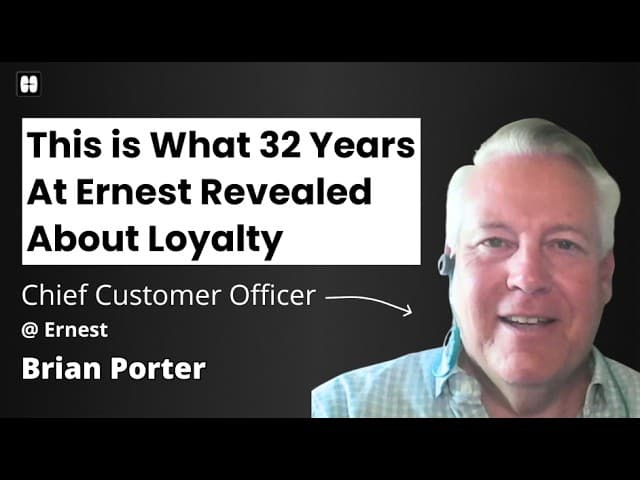
CX Heroes Podcast #49: Your Customer Can't Be Honest With Your Sales Rep
A sales rep spent three years taking his customer to ballgames and dinners. Brian Porter sat down with that same customer for one 45-minute conversation, no agenda and nothing to sell, and walked out knowing more than the rep had gathered in three years.
The rep called him afterward, half in disbelief.
"You found out more in 45 minutes than we have in three years."
Brian is the chief customer officer at Ernest, a packaging and distribution company he has helped grow from about 65 people to nearly 800. Last October his CEO handed him a new title and a loose mandate: go meet our top customers, get the highest-level decision maker in the room, and find out how we are really doing. No playbook. Figure it out.
He has now done 60 of those meetings. What he learned says something uncomfortable about how most companies collect customer feedback.
The relationship is the filter
Here is the part most teams miss. Your customer is not withholding the truth because they are difficult. They are protecting the relationship.
When the person across the table has a quota and years of golf invitations riding on the answer, the customer softens it. They round up. They leave the real frustration unsaid, because saying it out loud feels like betraying a friend. The dynamic that makes a rep effective at closing is the same dynamic that keeps honest feedback from ever reaching them.
This is structural, not personal. No amount of rapport fixes it, because rapport is the thing causing it.
Brian carries none of that weight into the room. No deal on the line, no number to hit. He shows up, asks one open question, scores the relationship one to ten, and lets the silence do the work. The decision maker finally says the thing they would never say to the rep.
He built the whole program with AI before he ran a single meeting
Before his first meeting, Brian sat down with ChatGPT, which he named Sally, and asked the basic question: what does a chief customer officer actually do? Sally pointed him to the research. He worked through "Customer Centricity" by Peter Fader and "The Ultimate Question," the book behind the net promoter score.
Then he went into the real world. He asked a CEO friend what a great CCO meeting felt like, and what a bad one looked like. The bad one was simple. The CCO tried to sell, and that account never took a second meeting.
Every detail went back to Sally. What to wear. Whether to carry an iPad or plain paper. How to take notes. AI did the prep. Brian did the room. That line is worth sitting with, because it is the opposite of how most companies are deploying AI into customer conversations right now.
The one rule that earns a second meeting
A chief customer officer who tries to sell in the meeting will never get invited back. So Brian does not. He asks how they are doing, scores it, asks for the next step, and follows up. When it is an owner or an executive, the follow-up is a handwritten note by mail. Old school, and it works every time.
What 60 conversations surfaced
Problems that had been sitting for months are finally getting fixed, because someone with no agenda elevated them. One rep had been stuck on an issue for two and a half months with no movement. Brian's meeting surfaced it, and within days it was handled.
His goal is 250 of these conversations by the end of the fiscal year. Everyone tells him that is crazy. He is doing it anyway.
There is a lesson here for any support or CX leader, and it is not "go hire a CCO." It is that the channel you use to listen shapes what you are allowed to hear. A rep hears a filtered version. A survey hears a polite version. A customer talking to someone with no stake in the answer finally tells you the truth.
That is also the quiet case for getting your self-service layer right. When customers can answer their own routine questions instantly, the human conversations that remain get to be the high-value ones: the honest, unfiltered, relationship-deepening kind that Brian is having 60 times over. Helpfeel exists to take the repetitive load off your team so the people on it are freed up for exactly that work, not removed from it.
The full episode covers the Toyota account Ernest lost over a forklift and a parking lot, how Brian uses AI without ever letting it touch the customer relationship, and why a packaging company rebranded around its people.