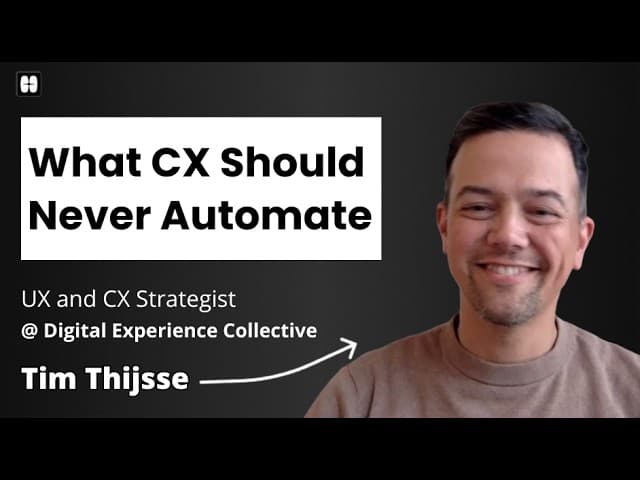
CX Heroes Podcast #50: Everything In Support Can Be Automated. That Doesn't Mean It Should Be.
Ask Tim Thijsse whether the support function will ever be fully automated and he gives you a one-word answer. Yes. Then he spends the next two minutes explaining why that is the wrong thing to aim for.
Tim is a UX and customer experience strategist operating from the Digital Experience Collective and the author of Maturing in Customer Experience Optimization. He is a top 50 CX leader in 2025 and again in 2026, and he has led digital optimization programs for brands like Heineken and E.ON. This is someone who has spent his career on the technical, quantitative side of CX. So when he draws a line around automation, it is worth paying attention to where he draws it.
The example that makes the point
Picture an insurance customer whose partner has just died. They need to cancel a policy.
You can automate that. Send a link, point them to a chatbot, let them close the account in thirty seconds. It is fast, it is efficient, and it is the wrong call.
Here is how Tim puts it:
"If somebody's passed away, it might be best to send a handwritten card, for example, or not send somebody to a chatbot, but ask for a certain time so you can have a call with that person, because that person just lost someone."
The interaction is simple to automate. The moment is not simple at all. And confusing those two things is how companies end up with support that runs smoothly and still leaves people feeling processed.
The skill is knowing which lever to pull
Tim's framing flips the usual order of operations. Most teams automate by default and try to add the human touch back in later, usually after a customer has already had a cold experience. Tim decides where empathy has to live first, then automates everything around it.
"This doesn't mean that you have to be automated at 100%. This means that you really understand what you should pull and when you should use that empathy of your employees and let them connect to the customer."
That is the part most automation projects skip. The question is not how much you can automate. The question is which interactions earn a person, and how you design the system so those moments are protected instead of swallowed.
Why this matters more as AI gets better
The better automation gets, the easier it becomes to route everything through it. That is exactly when the line Tim draws becomes valuable. A customer canceling a duplicate subscription and a customer canceling after a loss can look identical to a system and could not be more different to a human.
This is the worldview behind how we build Helpfeel. Good AI support is not about removing people from every interaction. It is about answering the high-volume, repeatable questions so reliably that your team has room for the moments that actually need them. Helpfeel resolves up to 70 percent of incoming questions and answers 98 percent of searches with a relevant result, which is what gives a support team the time to show up where a person belongs. The automation handles the routine so the humans can own the moments that carry weight.
Tim's episode is a good reminder that the boundary between automated and human is a design decision, not an accident. Draw it on purpose.