Your Customers Stopped Starting at Your Help Center
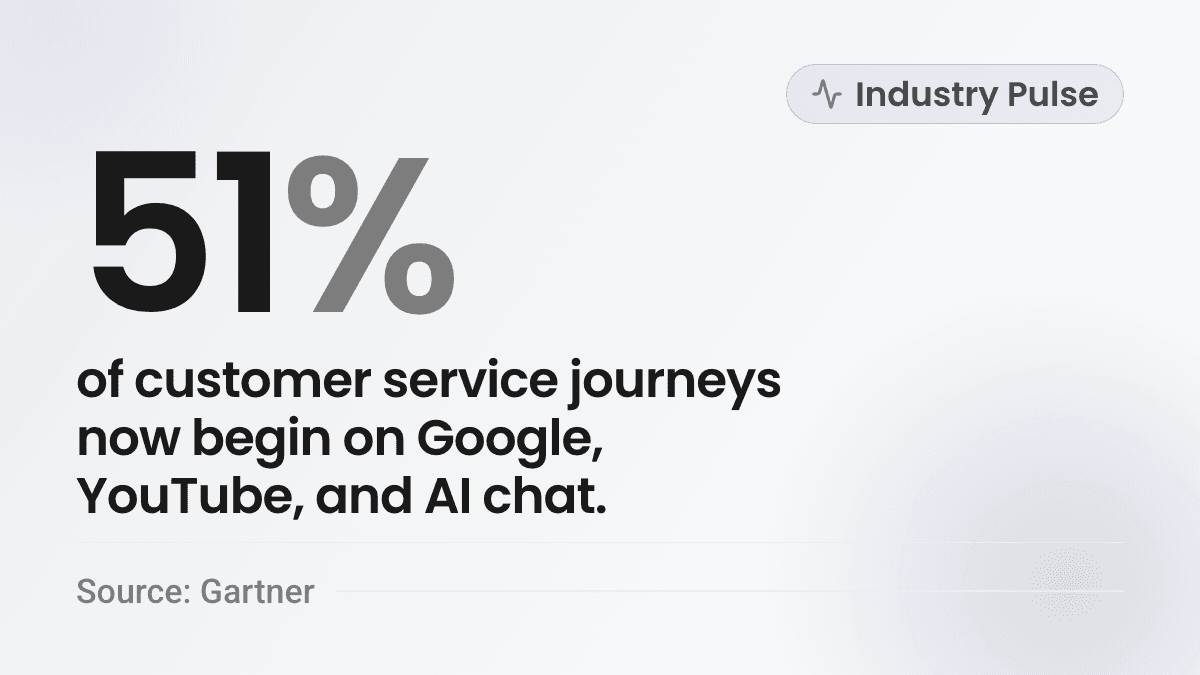
More than half of customer service journeys now start somewhere you do not control. Gartner puts it at 51%.
In a 2025 survey of 5,801 consumers, Gartner found that the majority of service journeys begin on third-party platforms like Google, YouTube, and ChatGPT, with search engines the most common first stop. Your help center is no longer the front door. It is the second or third room people reach, if they reach it at all.
That is a quiet shift with loud consequences.
The moment of need moved upstream
Picture the actual behavior. A customer hits a problem at 9pm. They do not log into your portal. They open a search bar or an AI assistant and type the question in plain words. Whatever answers first, wins the moment.
If the answer comes from a forum post, an old review, or a confident-but-wrong AI summary, that is the version of your product the customer now believes. You were not in the room. The answer happened to you.
Your knowledge is either extractable or invisible
Here is the part most teams miss. Search engines and AI assistants do not reward the company with the biggest help center. They reward the one whose answers are clean, structured, and easy to lift out of context.
A buried PDF, a login-gated portal, a wall of legacy FAQ pages written for an internal audience: none of that gets surfaced. The engines cannot read it, so the customer never sees it. You can have the right answer and still lose, simply because it was not in a form a machine could quote.
This is what answer engine optimization actually is. Not a new acronym to chase. A recognition that the question now gets asked outside your walls, and your job is to make sure the correct answer travels back in.
Your old metrics measured the wrong building
For a decade, support leaders optimized the help center as a destination. Sessions, search success, self-resolution inside the portal. Useful numbers. They just measured a building most customers now walk past.
The new question is harder and more honest: when someone asks about your product anywhere on the open web, does the right answer show up? That depends on whether your knowledge is verified, current, and structured for extraction. It is a content and architecture problem before it is a chatbot problem.
What good looks like now
Three things separate the companies winning the first answer from the ones getting answered for.
Their knowledge is verified, so the answer a machine lifts is the answer they would stand behind. Their content is structured in self-contained, question-shaped chunks an engine can quote without mangling. And it stays current, because a stale answer surfaced confidently is worse than no answer at all.
Get those right and the same knowledge base that serves your help center also feeds the search results and AI assistants where the journey now begins. You stop choosing between owning the destination and owning the moment of need. You own both, from one source.
The takeaway
The help center did not die. It stopped being the starting line. Your customers already moved upstream to wherever they can ask a question in their own words and get an answer in seconds. The only choice left is whether that answer is yours.
If you want to see what a verified, extractable knowledge core looks like in practice, take a look at how Helpfeel works.