
Set a clear buying decision for your document AI pilot
A document AI pilot should end with one decision: go, revise, or stop. Set that decision before testing starts.
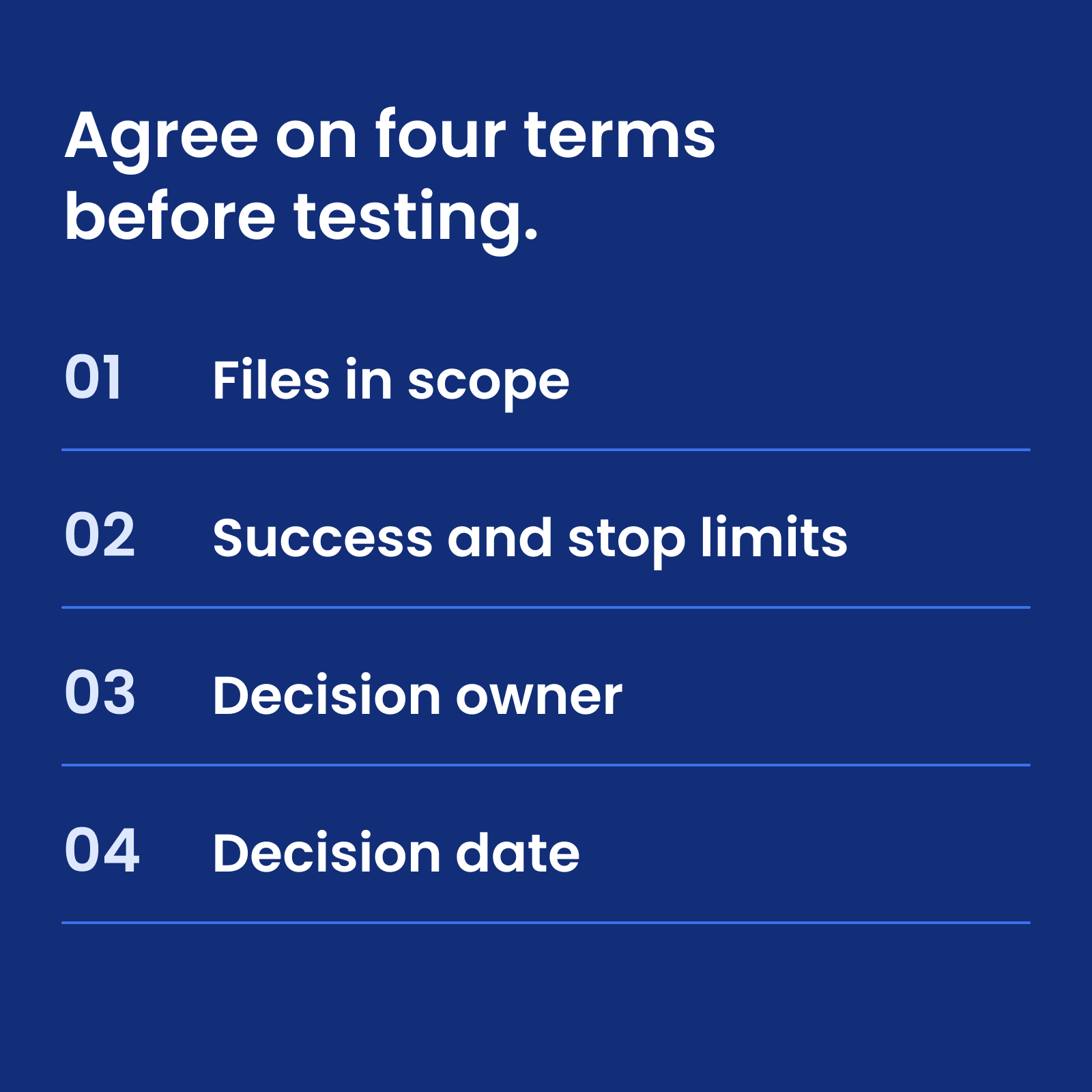
Use a one-page pilot decision brief for one recurring support or field-service document lookup. Limit the pilot to approved documents for one product family.
The brief names who decides, what evidence counts, what limits apply, and when the pilot ends. It also states the exact next step that a go decision would approve.
This proposed brief adapts controls from the National Institute of Standards and Technology's AI Risk Management Framework (NIST AI RMF) 1.0 and two UK public-sector guides.[1][2][3]
Use this brief to plan and record a proposed pilot.
Name who decides and what go means
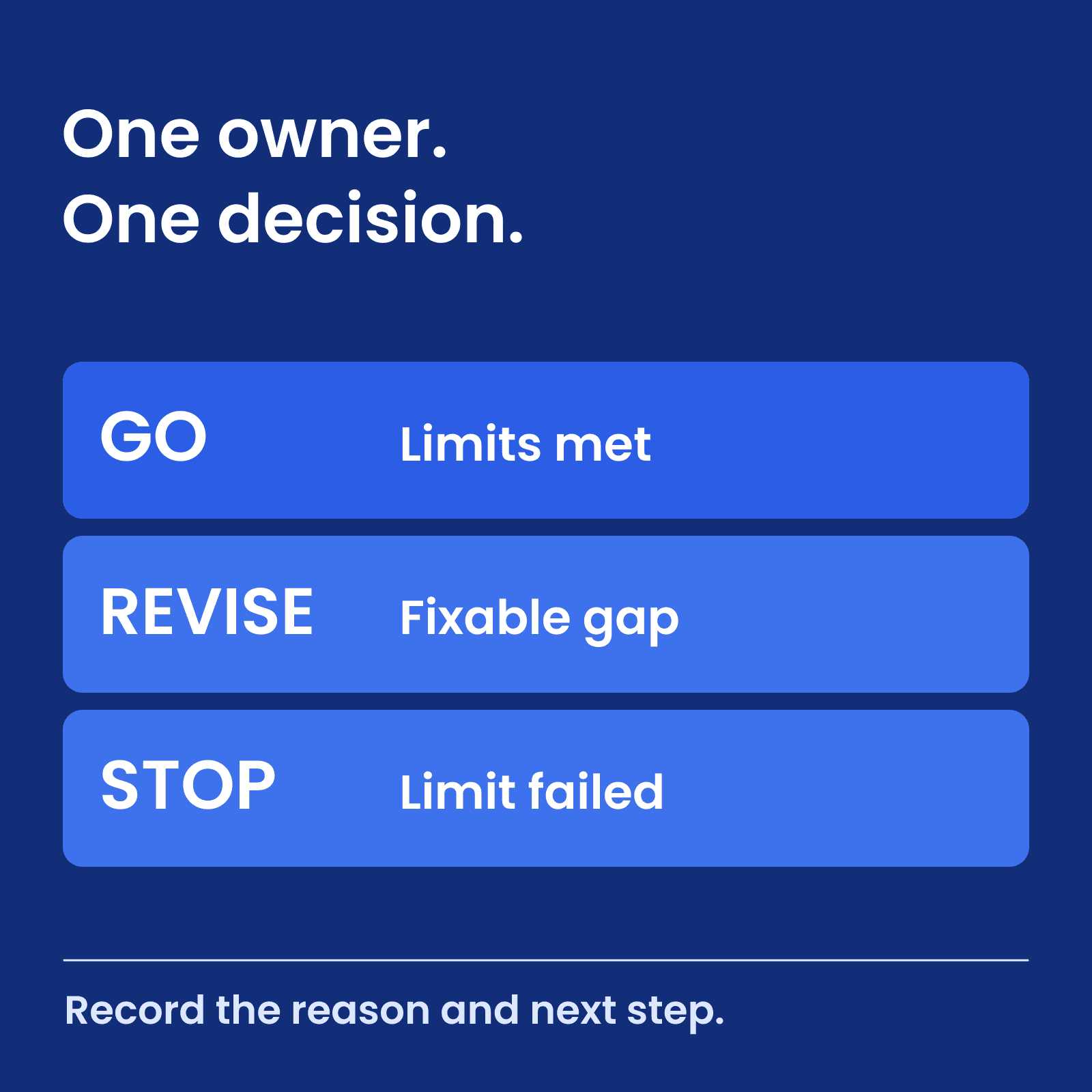
One person must own the final commercial decision. Name that person, the choice they can make, and the contributors whose input they need.
The decision owner may not be the technical reviewer. A product specialist may check an answer against an approved manual. Security, legal, procurement, and operations may review other parts. The decision owner gathers their evidence and records one outcome.
Define go before the pilot starts. State the exact next step it would approve, such as a procurement step, security review, or limited implementation assessment. Enterprise readiness, purchase, and production deployment each need a separate decision and approval.
Record:
- decision owner and job title
- decision authority
- required contributors
- exact next commercial step that go would approve
- approvals still needed after go
Fix the document scope before testing
List the exact approved documents for one product family and one recurring lookup that the pilot may use. NIST calls for teams to specify and document the intended use. UK procurement guidance treats data governance and access as project controls.[1][2]
For each file, record:
- file name and stable identifier
- revision or issue date
- approval status and permission owner
- permitted workflow
- people or systems allowed to access it
- storage location
- explicit exclusions
Add a file only through a recorded scope change. Stop before upload or testing if permission, revision authority, access rights, storage, or consent is unclear. Use only a file transfer method that the team has approved for confidential documents.
Decide what evidence will count
Set the evidence and pass limits before anyone sees the results. NIST calls for teams to document test sets, metrics, and tool details.[1]
Keep the commercial decision brief separate from the technical scorecard. Link to the technical result, then record:
- technical result reference
- reviewer effort and how you measured it
- actual pilot cost
- unresolved operating requirements
- status of every risk limit
Define each measure, owner, collection method, and pass limit in advance. Keep those limits fixed through the decision. Mark missing evidence as unresolved.
Keep each type of cost separate
Separate approved spend, estimates, and actual costs. NIST says teams should examine and document monetary and non-monetary costs tied to AI errors, function, and trustworthiness.[1] UK procurement guidance also covers lifetime costs such as support and maintenance.[2]
Record:
- approved vendor spend
- internal review effort and the buyer's chosen value for that time
- implementation or handling costs
- known ongoing support or maintenance costs
Convert internal hours to dollars only when the buyer has recorded how to value that time. Label unknown costs as unknown.
If actual spend exceeds the approved amount, choose revise for new approval or stop.
Set limits that stop the pilot
Separate non-waivable stop conditions from limits for which an authorized owner may approve an exception. A non-waivable breach stops the pilot. A breach of an exceptionable limit pauses testing until the owner records approval. NIST calls for organizations to set and document risk tolerance.[1] The UK government AI playbook says teams should reconsider AI use when risks are too high.[3]
Set limits for:
- document permission and revision authority
- data exposure and storage
- unsupported output
- prohibited workflows
- legal, safety, regulatory, and warranty ownership
- spending authority
For each limit, record whether it is non-waivable or name the owner who may approve an exception. Record any approval before work resumes.
For high-risk work, get the required approval and record the human review. A citation identifies the source to check.
Put the decision on the calendar
Set an evidence cutoff and decision date. UK procurement guidance calls for clear evaluation timeframes and go or no-go decision points where they apply.[2]
Record:
- evidence cutoff
- decision meeting date
- required attendees
- owner of the decision record
- one outcome: go, revise, or stop
An extension is a revise decision. It needs a newly approved date. If required evidence or the decision owner is unavailable, choose revise or stop.
End with go, revise, or stop
Use three outcomes. NIST asks organizations to decide whether an AI system serves its intended purpose and should proceed. Its options include recalibration, mitigation, and removal from use.[1] This article calls the commercial outcomes go, revise, and stop.
Go: Every non-waivable limit holds. The required evidence is present. Actual cost stays within authority. The named owner approves the next specific commercial step.
Revise: Missing evidence or other fixable gaps can be resolved within the approved use case, and no non-waivable limit failed. Record each required change and what stays fixed. Record any added approved cost, the owner, the evidence needed, and a new decision date. Stop if those fields remain incomplete.
Stop: Stop if a non-waivable limit failed. Stop if required permission is missing. Stop if cost exceeded authority without approval. Stop if required evidence cannot be obtained within the approved use case, or if the revision would create a different use case. Restart only with a new approved brief.
Copy this one-page pilot decision brief
| Field | Record before the pilot | Close at the decision |
|---|---|---|
| Decision owner | Name, authority, required contributors | Owner signature and recorded outcome |
| Meaning of go | Exact step a go decision would approve | Approval granted or withheld |
| Document scope | Files, revisions, permissions, workflow, users, storage, exclusions | Scope changes and unresolved permissions |
| Decision evidence | Technical result reference, reviewer effort, cost, operating requirements, risk status | Actual evidence and unresolved gaps |
| Cost record | Approved spend, effort basis, implementation and ongoing cost fields | Actual amounts, estimates, and unknowns kept separate |
| Risk limits | Non-waivable conditions and limits with exception authority | Breaches, approvals, and stop conditions |
| Date and outcome | Evidence cutoff, meeting, attendees | Go, revise, or stop |
The brief is complete when another qualified reader can see what the pilot allowed, what evidence the team reviewed, what limits applied, who decided, and what the decision approved.
If your team has one recurring document lookup to evaluate, read about Keyline for technical teams or contact Helpfeel to discuss a scoped paid beta. Start by naming the workflow, the team that owns it, and the document type. The initial inquiry needs only those details.
Sources
[1] https://airc.nist.gov/AI_RMF_Knowledge_Base/AI_RMF/Core_And_Profiles/5-sec-core - NIST AI Risk Management Framework Core [2] https://www.gov.uk/government/publications/guidelines-for-ai-procurement/guidelines-for-ai-procurement - Guidelines for AI procurement [3] https://www.gov.uk/government/publications/ai-playbook-for-the-uk-government/artificial-intelligence-playbook-for-the-uk-government-html - Artificial Intelligence Playbook for the UK Government