
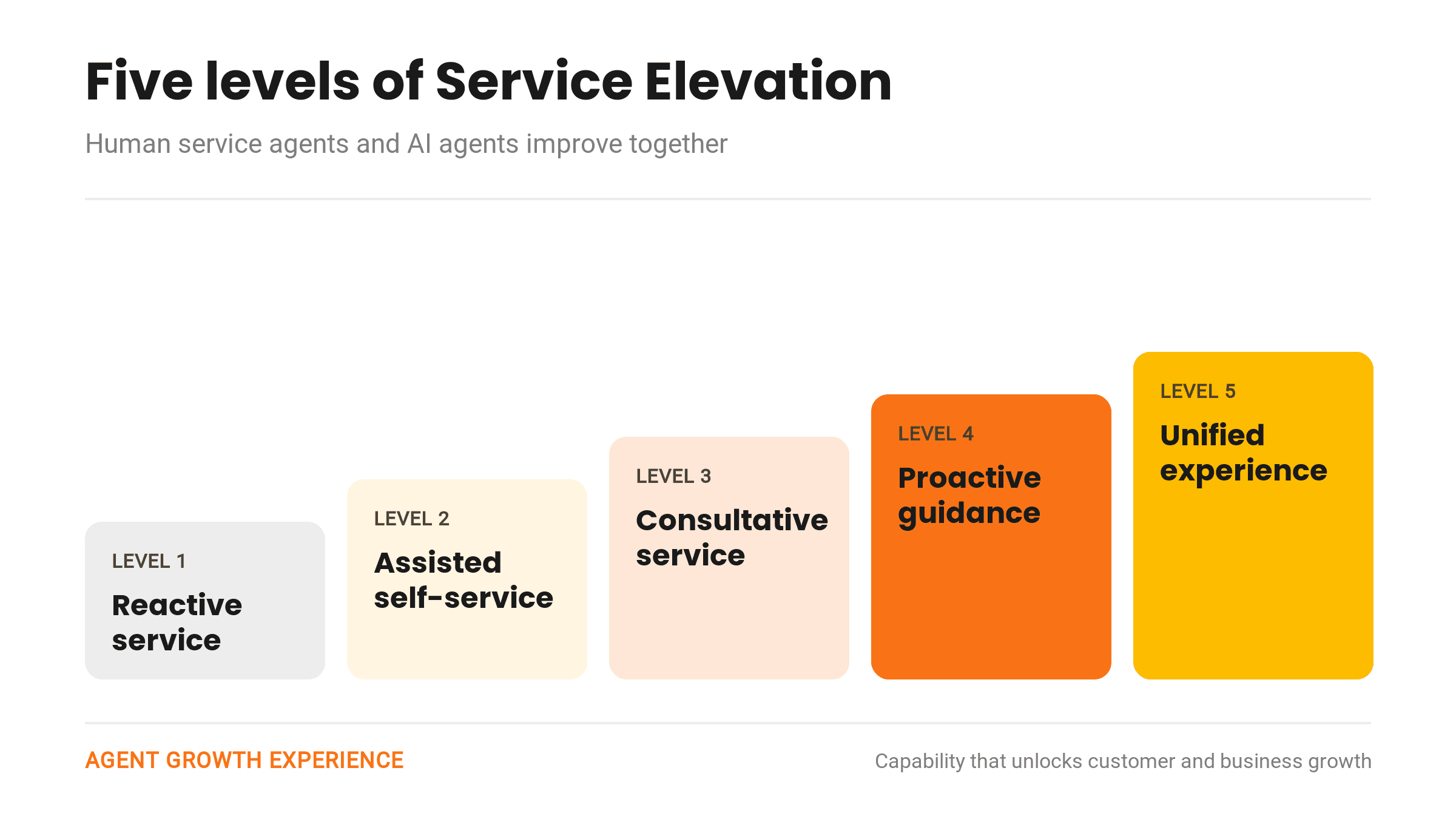
The Five Levels of Service Elevation

Helpfeel note: This guide adapts a Service Elevation draft from Nate Brown. The level names, descriptions, AGX framing, and product links are Helpfeel's additions.
A queue can be full and every dashboard green while the customer still carries the hardest part.
Service Elevation starts with that gap. Nate describes customer experience as making people's lives better and easier.
Customer expectations have risen alongside what service leaders can now design. AI agents can answer, route, act, and learn across workflows. Human service agents can spend more time on judgment, relationships, and improvement. The opportunity grows when those experiences are designed together.
Helpfeel calls that combined design approach Agent Growth Experience, or AGX. AGX treats the human service agent experience and the AI agent experience as one system. AI agents receive the strongest focus because their growing capability changes service work. That gives human agents more room to learn, guide, and improve the system. Together, they can help customers and the business grow. Cost savings matter. Customer and business growth matter more.
The five levels make the next transition visible.
How to use this maturity model
This maturity model helps you identify the dominant shape of service today and choose the next useful transition. It is a planning guide, not a grade. Each level describes observable behavior that you can use for planning.
One company can operate at different levels across journeys, products, regions, or channels. A routine account update may sit at a higher level than a sensitive claim or complex repair. The right design matches capability, customer need, and risk.
Look for evidence in how people spend their time, what agents complete, where knowledge lives, how decisions get made, and which customer signals reach the rest of the business.
Level 0 is the short pre-maturity baseline. Manuals and documents exist digitally. Their knowledge still needs structure before service teams or AI agents can use it reliably.
Service Elevation covers the whole service organization. Helpfeel uses the Autopilot Call Center model as a related technical view of AI-ready knowledge, workflows, system actions, supervision, and continuous improvement. Explore that technical capability view separately. Helpfeel's approaches to customer support and knowledge base management provide more context for the model's operating foundation.
The five levels at a glance
| Level | Public name | What you can observe |
|---|---|---|
| 1 | Level 1: Reactive service | The team responds to demand and begins building trusted knowledge for common needs. |
| 2 | Level 2: Assisted self-service | AI completes established routine work and assists people during the interactions that remain. |
| 3 | Level 3: Consultative service | AI follows defined procedures and takes approved actions while people handle complex needs and create customer value. |
| 4 | Level 4: Proactive guidance | Routine service runs end to end where appropriate, and people focus on exceptions, improvement, and guidance. |
| 5 | Level 5: Unified experience | Shared customer knowledge drives continuous improvement across the business. |
Level 1: Reactive service
At Level 1, the organization still works mainly in response to customer demand. People monitor queues, follow scripts, move information between systems, and escalate work to a small group of experts.
The leadership focus is operational stability. Volume, speed, adherence, handle time, and compliance dominate the dashboard. Those measures can keep a service operation healthy. They give a limited view of whether the customer reached a useful outcome or why the demand appeared.
Knowledge often comes from subject-matter experts and moves slowly. Common answers may live in a basic knowledge base, while procedural details remain scattered across manuals, folders, and people's memories. AI search or simple self-service can resolve familiar questions. Human agents still carry most of the context and execution.
Level 1 creates a dependable foundation. Repeated questions become visible, and leaders can turn service records into knowledge that people and agents can trust.
Observable evidence
- Most customer needs become live contacts.
- The same questions return across the queue.
- A few experts receive frequent interruptions for complex work.
- People copy information between systems to complete routine tasks.
- Leaders can describe workload more easily than customer or business impact.
One practical next move: Choose one common, well-understood journey. Expand its trusted knowledge from simple answers into the actual procedure, then measure whether customers reach a successful resolution. This creates a clean path into Level 2 without asking the whole operation to change at once.
Level 2: Assisted self-service
At Level 2, human service agents remain the primary operators, and AI takes on a meaningful share of routine work. Customers can resolve straightforward needs through self-service. During live interactions, AI can transcribe conversations, suggest reliable answers, surface procedural knowledge, and reduce after-call administration.
Agents spend less time searching and entering repetitive data. They supervise assisted work and step in when knowledge, policy, or system access reaches a boundary. Leaders can reallocate capacity toward work that needs more skill, care, or judgment.
Self-service quality becomes crucial here. The customer outcome tells you whether the channel works. Strong teams track successful resolution, first-contact resolution, customer satisfaction, sentiment, and quality.
Knowledge now reflects how customers actually ask for help. Agents start contributing what they learn, though ownership usually stays within the service department. Separate tools and data boundaries still create friction. Complex requests may require manual assembly, and cross-system needs can reach a dead end.
Observable evidence
- Routine needs often resolve without a live interaction.
- Agents consistently use transcription, answer suggestions, or workflow assistance.
- After-call work is smaller and more standardized.
- Complex needs still require people to gather context from several systems.
- Most knowledge improvement remains inside the service team.
One practical next move: Connect one trusted procedure to the system where action happens, such as a CRM. Give the AI agent a bounded action it can take with clear approval rules. Train human agents to review exceptions, improve knowledge, and identify root causes. Then bring one recurring customer learning into a regular cross-functional meeting.
Level 3: Consultative service
Level 3 changes the role of service. AI performs beyond novice level on defined work. It can follow conditional procedures, route decisions, and take approved actions through connected systems. Human agents concentrate on complex resolution, sensitive decisions, customer relationships, and improvement.
The ticket becomes a source of insight. A strong agent looks beyond the immediate answer and asks what would prevent the next issue, what outcome the customer is trying to reach, and what the wider organization should learn. Service begins to influence product, policy, operations, and customer success.
New roles and skills emerge. Service engineers improve workflows and knowledge. Other people focus on consultation, community, quality, or customer learning. Their judgment makes the whole system more capable.
Knowledge crosses department and system boundaries. People and AI agents can identify gaps during real work and feed improvements back into the source. Customer learning starts producing documented changes outside the service team. Measures expand toward customer effort, sentiment, quality across human and automated work, renewal, retention, and the outcomes of improvement projects. Leaders should separate useful correlation from proven business causation.
Observable evidence
- AI agents complete defined conditional work and take approved actions in connected systems.
- Human agents can find reliable answers for most needs without interrupting an expert.
- Exception handling has clear owners and decision rights.
- Customer learning regularly causes a product, policy, process, or knowledge change.
- Service people spend visible time improving the system and guiding customers.
One practical next move: Select one routine workflow that is ready to run end to end. Define its stop conditions, exception paths, human approval gates, and readback. Add observability across self-service, assisted service, and human service so the team can see what happened and improve the workflow safely.
Level 4: Proactive guidance
At Level 4, routine service runs end to end where appropriate. AI agents follow approved decision paths, connect information across systems, and take bounded action. Human agents set policy, supervise risk, resolve exceptions, improve the system, and guide customers before a familiar hurdle becomes a problem.
The organization becomes smarter with every interaction. Customer learning can reach other teams through shared data flows and operating routines. Leaders measure resolution across service tiers, customer health, future behavior after service, and the effect of improvement work.
Observable evidence
- Routine workflows complete across systems with clear controls.
- People focus on exceptions, relationships, proactive engagement, and system quality.
- Customer signals move to other teams without waiting for a periodic presentation.
One practical next move: Give product, service, success, marketing, sales, and leadership access to shared customer context. Assign cross-functional ownership to one experience improvement and measure its before-and-after result.
Level 5: Unified experience
Level 5 is an intentionally ambitious destination. AI agents autonomously run the service work selected for automation, including bounded discretionary decisions and exceptions. People define goals, judgment, ethics, relationships, and the next improvement opportunity.
Fresh customer knowledge drives continuous improvement across the business. The lines between support, service, success, marketing, and sales become less important because teams share context, measures, and responsibility for customer outcomes. Knowledge is the core asset, and high-value human input makes every agent more capable.
Observable evidence
- Teams share fresh customer context across traditional department boundaries.
- Voice of Customer learning drives controlled, measured improvement across the business.
- Human service professionals gain skill, scope, judgment, and influence.
One practical next move: Choose one customer outcome that crosses several departments. Create shared ownership, connect the relevant knowledge and signals, and define where people retain judgment. Automate the learning cycle only where evidence and risk allow.
Elevation starts with the next transition
Level 5 will look different for every company and customer. Its value lies in giving service leaders a direction to explore while the earlier levels provide practical work to do now.
Start with one journey. Find the evidence for its current level. Choose one transition. Improve the knowledge, workflow, and decision rights together. Then help your human and AI agents grow through the work.
Helpfeel's AGX perspective adds one working principle: Service elevation happens when every agent becomes more capable, and that shared capability creates new value for the customer.
If you want a partner for your next transition, start a conversation with Helpfeel.