
Loop Ownership 101: How to Run Your First AI Loop
Your new AI agent went live. The launch team moved on. The first exception arrived. Who owns what happens next?
When a production agent hits an exception, your org chart gets very real.
That first exception is where AI projects become operations.
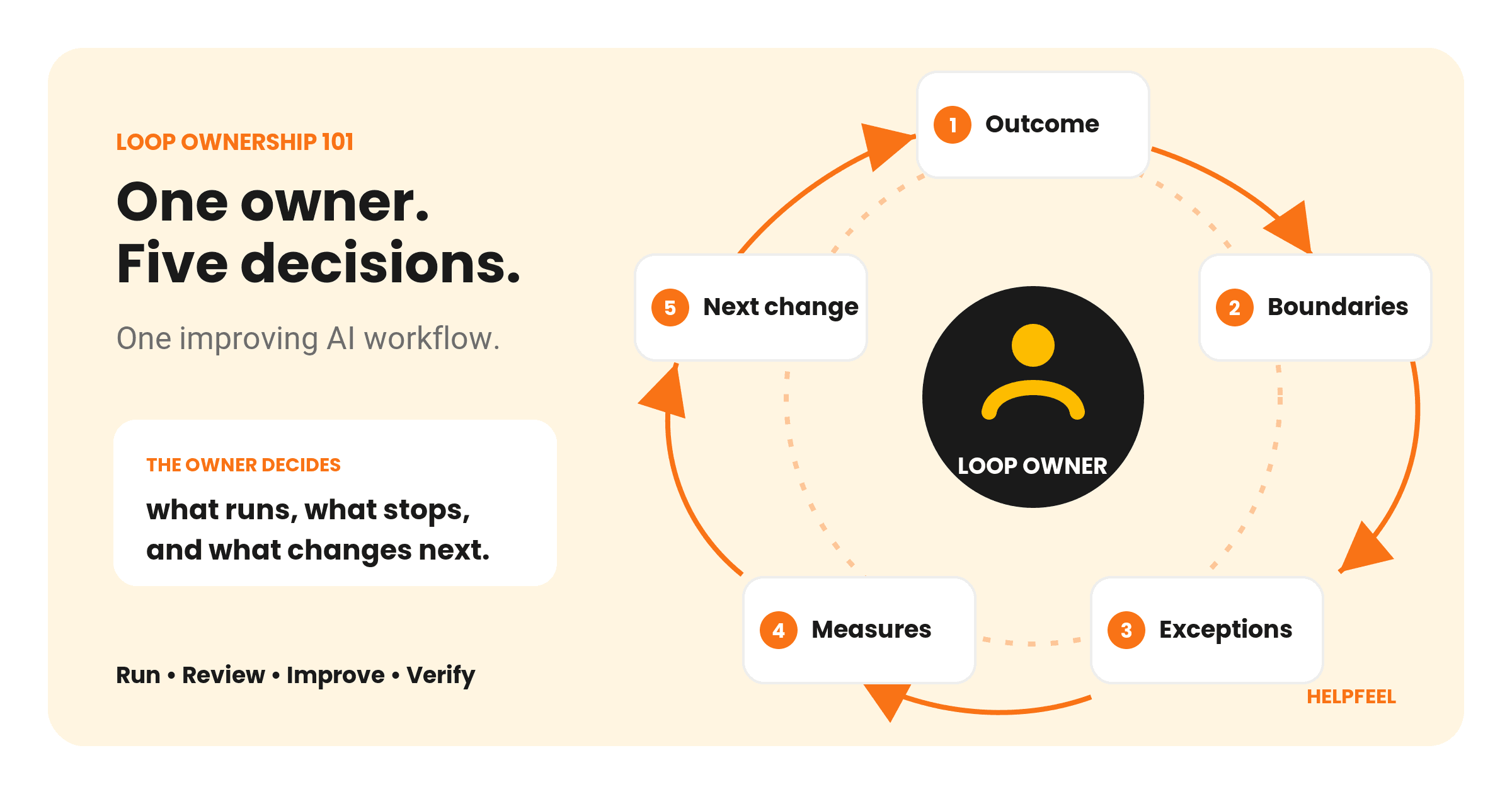
A loop owner is the named person who owns the business outcome, boundaries, exceptions, measures, and next improvement decision. Technical teams still own models and infrastructure. The loop owner owns what the workflow does to the customer and the business.
Launch day starts the real work
A demo gets judged in minutes. A production agent gets judged every time the workflow changes around it.
And it will change. Source data moves, policies change, tools return unexpected errors, and customers ask questions nobody included in the test set. Sometimes the agent completes its assigned step while the next team still can't use the result.
The launch didn't fail. The agent is now working inside a living business.
Tim Thijsse put the risk plainly on CX Heroes:
"it might also be something in the operation where there's a handover just lacking or is leaking information, your data is not complete or incorrect."
That is the handoff sitting inside the opening scene. The agent ran. The workflow still needs a person who can protect the customer, find the cause, and decide what changes next.
Handle the first exception
Start by stopping the normal path and keeping the evidence. The input, the output, the tools used, the handoff, and the failed completion check all belong with the case.
Now protect the customer outcome. A fast support answer followed by a repeat contact has failed downstream, even if the agent's own task shows complete. Route the case to a named person with the context and authority to act.
"Ask a human" isn't enough. Which human? With what context? By when?
Then classify the cause. Model or tool behavior belongs in one group; broken steps, unclear policy, and bad source data belong in another. Human execution may belong in a third. Every failure needs a cause before it gets a fix.
The green checkmark can wait.
Once the team understands the cause, change one bounded thing. State what should improve, test it against historical cases, release it through the right gate, and compare the new evidence with the baseline. The loop owner decides whether to keep, revise, or reverse the change.
Run one weekly loop review
Bring the first exception into the weekly review as evidence. Then look for the other cases that share its cause. This keeps the meeting focused on removing a class of failure. One memorable example becomes evidence for a wider pattern.
Review these five items in order:
- Outcome movement: Did the customer and business measures improve, stay flat, or decline?
- Incorrect or incomplete work: Which outputs failed the quality or completion test?
- Stops and human interventions: Where did the agent stop, escalate, or require correction?
- Workflow changes: Did knowledge, policy, tools, permissions, or source systems change?
- One experiment: Which single approved change will the team test next?
Leave with one owner, one change, one expected effect, and one verification date. A long list with no decision means the loop didn't close.
Your first 30 days as a loop owner
Use the first month to narrow uncertainty before you expand authority.
Week 1: Map and baseline
Map the workflow from trigger to verified outcome. Include the point where that first exception left the normal path, the evidence that traveled with it, and the person who received it.
Then measure the current process. You need a baseline for quality, time, cost, customer outcome, and human effort before the agent changes them.
"Use an AI agent" is an implementation choice. It isn't an outcome.
Week 2: Shadow and classify
Run the agent beside the current process without allowing customer-facing or live-system changes. Compare both the outputs and the paths used to produce them.
Classify every disagreement. Don't hide a broken workflow inside a model-quality score.
Week 3: Launch narrowly and verify readback
Choose a low-risk case type with clear rules. Limit the agent's users, volume, tools, or permissions.
For every write or external action, read the target back. A successful tool response isn't proof that the business record changed as intended.
Week 4: Review outcomes and approve one expansion
Compare the first production evidence with the baseline. Check customer outcomes, task quality, downstream work, exceptions, human review, cost, and speed.
Then make one decision: keep the current boundary, narrow it, stop it, or approve one expansion. Evidence determines whether the workflow earns more authority.
Related reading
- AI agent operations: define the full operating model for owned AI workflows.
- Customer support: connect repeatable work, human judgment, and self-service.
- The Helpfeel platform: see how Helpfeel combines AI agents, knowledge, and continuous improvement.
Loop ownership changes the human role
As AI agents take on more execution, service professionals gain broader responsibility for judgment, customer relationships, system quality, and improvement.
That is the human side of Agent Growth Experience. A person who used to process each request can now see patterns across requests, fix the system behind them, and protect the customer when the normal path breaks.
The loop owner needs the authority to define what good looks like, stop the workflow, and approve the next change.
Operating loops pair agent execution with human judgment: each run produces evidence that the loop owner uses to improve the next cycle.