
Route routine lookups before specialist review
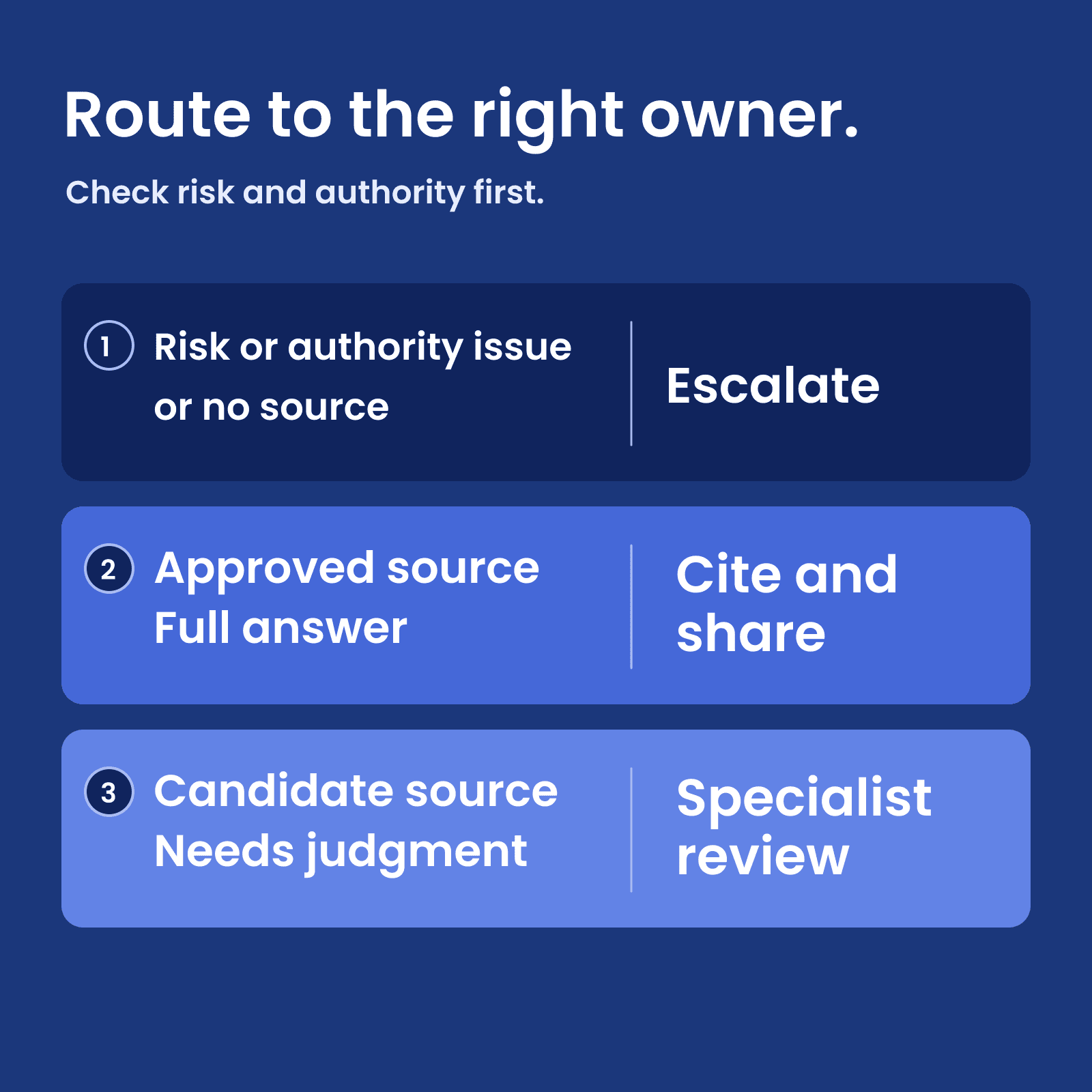
Route each technical request by its source evidence and the authority needed to answer it. Use one of three paths:
- Routine lookup: An approved source supports the complete answer.
- Specialist review: A candidate source exists, but applying it requires product judgment.
- Escalation: The evidence, authority, or risk requires another owner to decide.
This article proposes a team process for routing technical questions.
Skills England ST0071 v1.3 offers a useful cross-sector role reference. It describes a customer service specialist as a referral point for complex or technical requests and an expert who shares knowledge.[7]
Start every request with a source check
Active risk, a rule-based urgency threshold, or a known authority boundary can send a request directly to escalation. Use the source check first for all other requests.
Before routing a request, record:
- the requester's exact question
- the product family, model, configuration, and operating environment, when known
- the permitted sources and their owner
- the urgency and potential impact
- the responder's authority to answer, correct knowledge, or make a governed decision
Then ask: Does a maintained, permitted source support the full answer in this exact context?
KCS supports capturing the requester's context, searching with that context, linking the matching article, and providing the knowledge.[1]
Check the product, configuration, and audience approval in the full source record. Matching terms can appear in a manual for a different configuration.
If the evidence does not support an answer, keep the request unresolved.
Routine lookup: answer from the source
Use a routine lookup when a maintained, permitted source answers the question in full. Confirm the product, model, conditions, units, and other qualifiers. Also confirm that the source is approved for the audience and that the responder can share the answer.
For example, a field technician might ask for a document identifier in an equipment manual. Keep that request as a routine lookup only if the approved manual covers the exact product model.
Give the answer with the document, revision, section, page, or source region. Link the source to the request. Do not add an interpretation that the source does not support.
Move the request to specialist review if the source is incomplete, unclear, or hard to apply. KCS recommends visible article confidence and technical review when confidence is absent.[3]
Specialist review: ask a specialist for judgment
Use product-specialist time for judgment after the source search.
Specialist review applies when you found a candidate source but still need product judgment to use it. KCS says licensed contributors can fix minor article problems when confident. Otherwise, they flag the article for subject-matter-expert attention.[2]
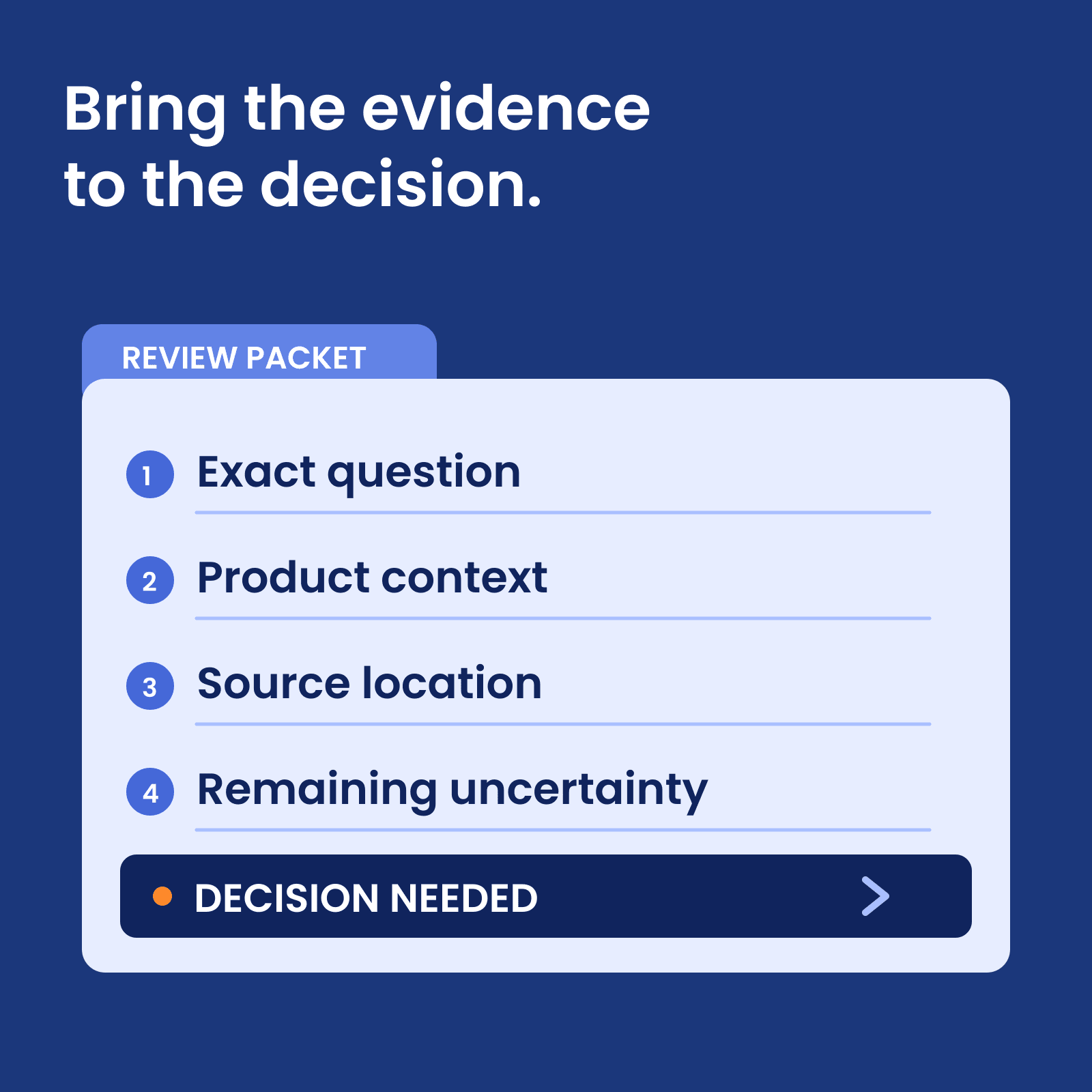
Send the specialist a compact decision packet:
| Field | What to include |
|---|---|
| Request | Stable ID and exact question |
| Context | Product, model, configuration, environment, impact, and urgency |
| Source | Permitted document, revision, section, page, or source region |
| Current finding | What the source appears to support |
| Uncertainty | The missing condition, conflict, or interpretation that blocks an answer |
| Work completed | Sources searched and checks already performed |
| Decision needed | Answer, decline, approve, correct, flag, or escalate |
The specialist should return a supported answer or decline to answer. The response should identify the authority used. The specialist may correct or flag a source only within their authority. If correction or approval belongs to another owner, the specialist flags or routes the content to that owner instead of deciding the change.
Move the request to escalation if the specialist cannot establish a supported answer. Keep its status unresolved.
Escalation: send the decision to its owner
Use escalation when resolution needs authority or expertise beyond product review:
- no maintained source supports the answer
- permitted sources conflict or have unclear authority
- the request falls outside the team's authority
- engineering, safety, legal, regulatory, warranty, or policy ownership is required
- there is a plausible active risk of harm
- impact, scope, duration, or urgency crosses an organizational rule
- product review cannot establish a supported answer
Carry the specialist review packet forward. Add the named owner, the decision required, and the reason product review stopped. This preserves completed work while transferring the decision.
For AI-assisted work, NIST AI RMF 1.0 calls for clear human roles and responsibilities in decisions and oversight. It notes that some systems may require human oversight.[4] This voluntary, non-sector-specific guidance also prioritizes documented risks by impact, likelihood, and available resources.[4]
The NIST AI RMF Playbook offers non-prescriptive actions. It lists physical safety, legal liability, and regulatory compliance among risks to prioritize.[5]
Atlassian calls skill-based or system-based routing functional escalation.[6] Its incident-management guidance supports only that routing step in this workflow.
Use resolved requests to improve the source set
After resolution:
- Link the final source or recorded decision to the request.
- Correct or flag shared knowledge only within the contributor's authority.
- Route governed content to its designated owner.
- Keep the request unresolved when evidence is absent.
- Review repeated specialist reviews and escalations for issues worth investigating.
KCS treats active risk of customer harm as a reason for immediate escalation to an accountable expert.[3] It assigns policy, regulatory, legal, and other compliance-governed content to designated owners.[3]
Repeated specialist review requests may point to unclear sources. Repeated escalations may point to missing ownership, conflicting authority, or a recurring question that needs a maintained answer. Treat these patterns as questions to investigate.
Test the boundary on one recurring lookup
Use three questions:
- Does a permitted source support the complete answer? Use a routine lookup.
- Does applying a candidate source require product judgment? Use specialist review.
- Does the decision require different authority or expertise? Use escalation.
Compare the workflow with your current method on one recurring manual lookup. Record where requests land, what evidence reviewers need, and whether the handoff preserves completed work.
After that test is defined, read about Keyline for technical teams or contact Helpfeel to discuss a paid beta. Share the workflow, the team that owns it, and the document type. The initial inquiry needs only those details.
Sources
[1] https://library.serviceinnovation.org/KCS/Knowledge-Centered_Success_Practices_Guide/101-Why_KCS_Works - Why KCS Works [2] https://library.serviceinnovation.org/KCS/KCS_v6/KCS_v6_Practices_Guide/030/030/040/030 - Technique 4.2: Flag It or Fix It [3] https://library.serviceinnovation.org/KCS/KCS_v6/KCS_v6_Practices_Guide/030/040/010/030 - Technique 5.2: KCS Article State [4] https://nvlpubs.nist.gov/nistpubs/ai/NIST.AI.100-1.pdf - Artificial Intelligence Risk Management Framework 1.0 [5] https://airc.nist.gov/airmf-resources/playbook/manage - NIST AI RMF Playbook: Manage [6] https://www.atlassian.com/incident-management/on-call/escalation-policies - Escalation policies for effective incident management [7] https://skillsengland.education.gov.uk/apprenticeships/st0071-v1-3 - Customer service specialist